
During the 20 years I’ve worked in philanthropy, I have had the great pleasure of working with individuals and families to help them plan their giving and align their grantmaking with their values to make it as impactful as possible. After all these years, what I know is that giving ought to be one of the most joyful experiences in life. Yet we often hear from our members that it can feel overwhelming.
For many families, experiencing a wealth event can result in an inflection point that initially impedes giving, rather than amplifying it. We see families that have been giving for years — to their alma mater, their kids’ schools, their houses of worship — but suddenly they feel stuck, uncertain of their philanthropic focus and impact.
In The Giving Journey, an Open Impact report by Heather McLeod Grant and Kate Wilkinson, this phenomenon is known as “the pause.” Philanthropists find themselves asking, “Am I doing enough?” and “How do I know if my giving is actually making a difference?” While professional advisors can often help with financial modeling, investing, and tax planning, families are often left grappling with the why, what, and how of their giving. These four strategies can help you move through the pause, and give with greater intention, confidence, and impact.
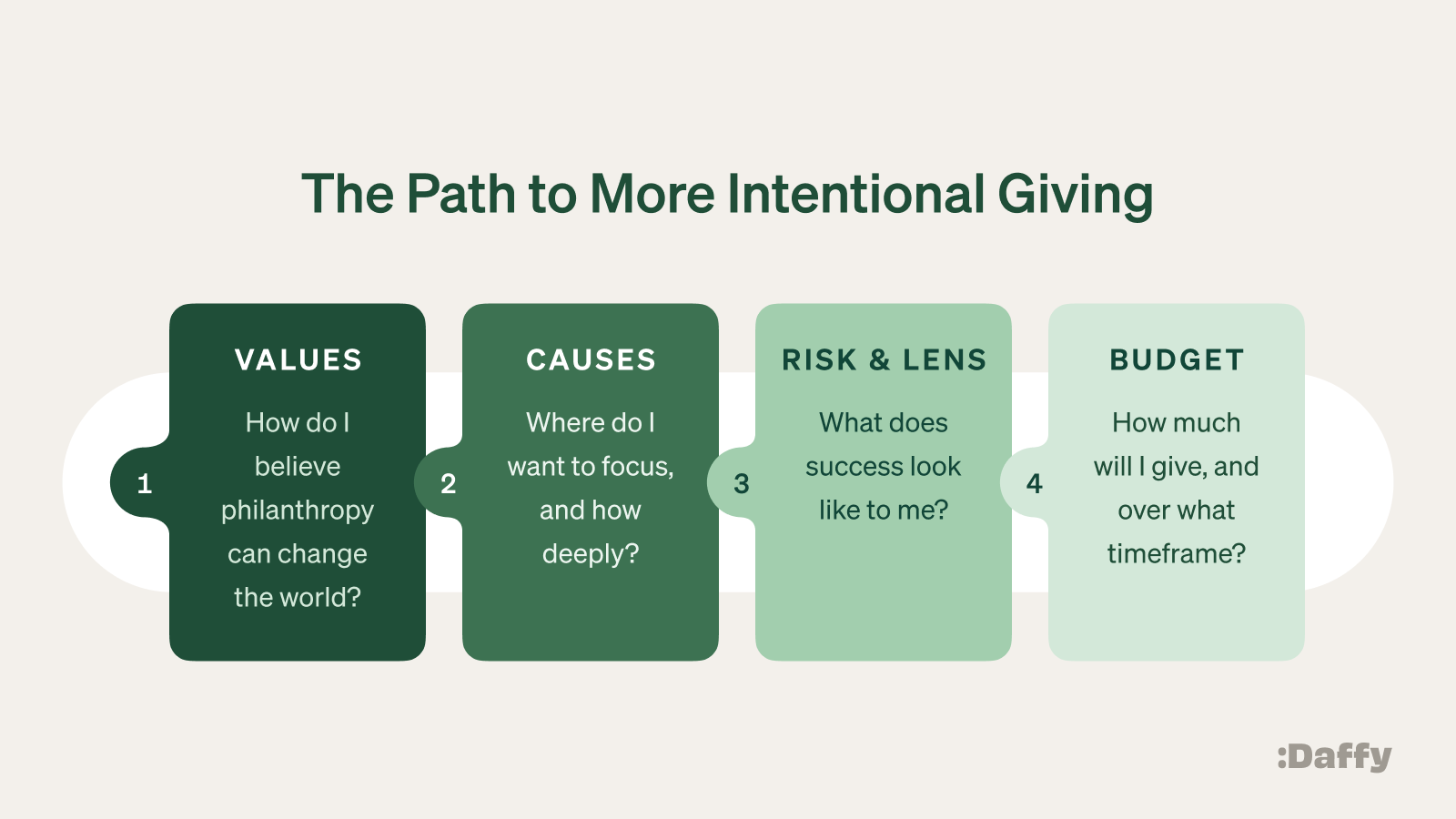
Start with Your Values
Before you make a single donation, take time to get clear on why you give. What are the core values that drive you and your loved ones? How do you believe your philanthropy can change the world?
A family was deeply inspired by their son, who was born with a rare congenital heart defect. Rooted in their family values around health, science, and collaboration, they partnered with a research hospital to fund transformative research and support for families to improve quality of life. What started as a single research grant has grown to an ongoing partnership, advancing critical research and serving generations of families to come.
Articulating your values isn't just a feel-good exercise. It becomes the north star that guides every decision that follows: which causes you support, how much risk you take on, and which organizations earn your trust. Without this foundation, giving can feel reactive and scattered. Aligning your values with your giving goals can take your philanthropy to the next level: intentional and impactful.
Get Clear on Your Causes
Once you have your values in hand, it's time to translate them into a giving focus. Start by looking backward: what have you been funding, and how do you feel about it? Then look outward: what are all the areas you care about? For instance, education, climate, health equity, arts, economic mobility?
From there, narrow in: What do I want to focus on right now? You don't have to solve every problem at once. In fact, concentrated giving tends to yield deeper relationships with charities and more visible impact over time. Giving yourself permission to focus is one of the most strategic decisions a donor can make.
Following an IPO, a philanthropist was torn between using all of their philanthropic assets to build a community center or making smaller donations to a variety of charities working to create affordable housing - both driven by their community values but in very different cause areas. They decided to take a learning approach by starting with smaller amounts to affordable housing charities, recognizing there would be time and resources to shift focus in the years to come.
Understand Your Risk Tolerance and Giving Lens
How you feel about your giving requires honest self-reflection about what "success" means to you — and how you'll respond and adjust when things don't go as planned.
Ask yourself:
- What kind of return am I expecting? What outcomes would make me feel that my giving had impact?
- How much do I value measurability? Some donors prioritize data-driven, measurable outcomes; others are comfortable funding work whose impact is harder to quantify.
- How risk-tolerant am I? Are you comfortable funding a bold new idea that might fail, or do you prefer supporting proven, established programs?
Give yourself permission to experiment and learn.
A family made a big bet funding a bold initiative to improve K-12 education in a traditionally underserved community. After several years, the work was regarded by some as having been unsuccessful because traditional metrics like test scores did not improve dramatically. However, the family valued innovation and used the initiative to build and test new education models for personalized learning and teacher training that they carried into future philanthropic funding.
It also helps to identify the lens through which you give. Are you drawn to direct service — meeting immediate, tangible needs? Or are you more interested in systems change, policy reform, or funding root-cause solutions? Maybe capacity building — strengthening the organizations themselves — resonates most. You can even use different lenses for different causes. There's no wrong answer, but knowing your lens(es) helps you find and evaluate charities that align with your approach.
Set a Budget and Define Your Goals
Thoughtful giving requires financial intentionality. A few key questions to guide your planning:
- What is your time horizon? Are you giving with a short-term focus, or building toward a multi-year philanthropic legacy?
- How will you budget? Annual giving plans work well for many donors, which is why we encourage every Daffy member to set an annual goal for their giving; others prefer multi-year commitments that allow charities to plan ahead.
- Do you want to go wide, deep, or both? Especially in an early "startup phase," some donors spread smaller gifts across many causes, testing different lenses, to learn what resonates; others go deep with fewer organizations. Thinking about what approach feels right to you and anchoring it to a budget can help you measure effectiveness.
- Do you need a discretionary budget? Setting aside some flexible funds lets you respond to emergent needs, solicitations from friends and family, or causes that move you unexpectedly, without derailing your core strategy.
A family that went through an IPO found themselves overnight with a significant sum to give away. When I met with them, their financial advisor had suggested they give away 1% of their corpus each year, which was around $25 million. They were overwhelmed at the notion of going from giving away a few thousand a year to eight figures. We picked initial cause areas and developed a budget that gave them time to ramp up funding as they felt more confident about those causes and organizations, and allowed for a small amount of reactive funding to support requests from friends and family.
Now, Find Your Organizations and Start Giving
With these strategies in mind, go out and find the best organizations to support. Tap your networks, talk to friends and colleagues who share your values, and consult trusted resources like Candid and Charity Navigator. Consider collaborating with peers to learn about causes and organizations through giving circles like SV2 or Grapevine. When you've identified candidates, do your own due diligence by reviewing annual reports to assess organizational health and impact, or by volunteering.
Once you've done the work, trust yourself and start giving based on your budget. The pause is real, but it doesn't have to be permanent. With a clear sense of your values, your focus, and your risk tolerance, you'll find that the hardest part isn't finding organizations worth funding, it's choosing between all the ones that are.
The families I've worked with who give most joyfully aren't necessarily the ones who give the most. They're the ones who know why they give, and what impact means for them. Get that right, and everything else follows.