
There’s no shortage of discussion around how some of the greatest wealth creation in America is happening long before companies go public. Trillions of dollars are now held in private or restricted stock in venture-backed companies.
Fortunately, more employees and investors are choosing to use that stock to give back. Through August 2026, Daffy received contributions of more than $600 million in private and restricted stock, over 4x the amount contributed in all of 2025. And it’s not just founders and venture capitalists. So far this year, private stock contributions to Daffy have ranged from as little as $3,000 to more than $5 million.
At Daffy, we pride ourselves on using technology to help people be more generous. We've worked to make donating private stock easier and more accessible, opening up opportunities that were once largely reserved for the wealthiest donors.
When people learn about donating private stock, invariably one question comes up: What happens to those shares after they are set aside for charity?
Even among donor-advised funds (DAFs) that accept private stock, like Fidelity Charitable or DAFgiving360, contributed shares are typically sold at the earliest available opportunity. Holding shares longer or recommending how many shares to sell can require multiple phone calls and seven-figure account minimums. And even then, these options aren't always available.
We believe there’s a better way… and now it’s live. 🚀
Introducing Custom Liquidation for Private Stock
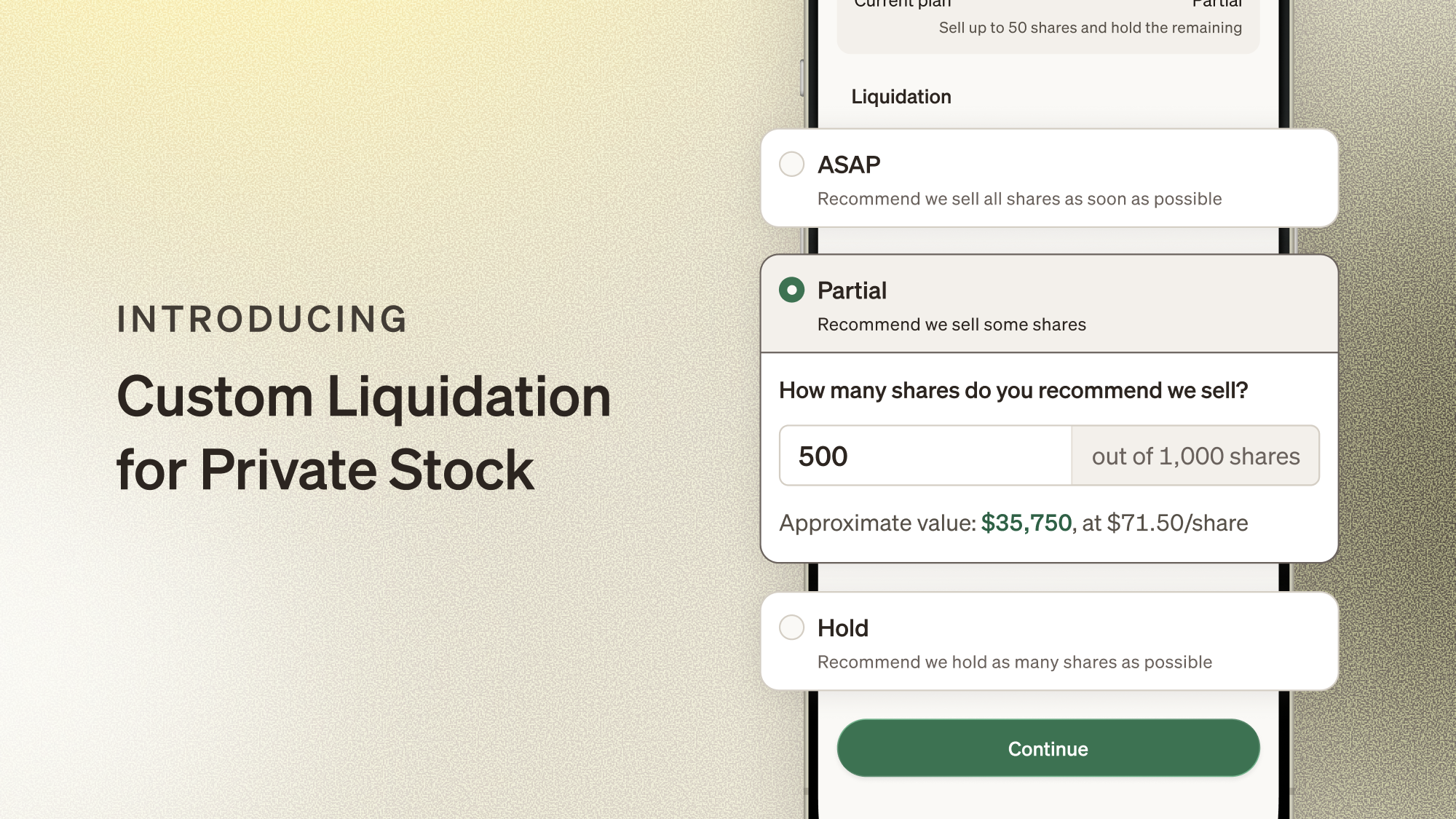
Today, we are proud to introduce Custom Liquidation for Private Stock, giving every Daffy member with contributed private or restricted stock a simple way to recommend when and how shares should be sold when liquidity opportunities arise.
Members can now choose from three options directly through Daffy:
- ASAP (the default): Recommend selling shares at the first available opportunity.
- Partial: Recommend selling a portion of the shares while holding the remainder.
- Hold: Recommend continuing to hold shares for potential future appreciation.
The best part? Members can submit these recommendations 24/7 directly through our app or website, without the multiple phone calls and emails traditionally required to manage private stock contributions.
This builds on the flexibility we introduced last year with Custom Liquidation, allowing members to recommend whether contributed public stock should be held, sold over time, or liquidated immediately. We later added Partial Stock Liquidation, allowing members to recommend selling only what’s needed to fund a donation recommendation while leaving the remainder invested.
Now, we're bringing that same flexibility to private and restricted stock.

Making It Simpler for Employees and Investors to Donate Private Stock
There are three big reasons why people do not donate private stock:
- They don’t know that you can donate private stock.
- Most charities do not accept private stock donations.
- Most donor-advised funds sell private stock as soon as possible.
At Daffy, our mission is to help people be more generous, more often. With Custom Liquidation for Private Stock, Daffy now solves all three barriers. 🎉
Consider an employee at Stripe who contributes 1,000 shares of company stock to their donor-advised fund at Daffy.
A few months later, Stripe announces a tender offer, creating an opportunity for eligible shareholders to sell some of their stock. The employee wants to support several charities in the near term.
With Daffy, the employee can now recommend selling 500 shares during the tender offer to make those funds available for charitable donations, while the remaining 500 shares are held for potential future appreciation.*
Do you have appreciated private stock? Contribute a portion of it to Daffy today and give us your liquidity recommendation.
Already contributed private stock? You can set a new liquidity recommendation for any private stock held in your fund.
Daffy is the Donor-Advised Fund for You™.
*Please note: As with all donor-advised funds, these are recommendations, not binding instructions. Daffy Charitable Fund retains legal ownership and ultimate discretion over contributed assets, including liquidation decisions. Participation in any liquidity event is also potentially subject to company restrictions and transaction terms.