
Think about the last time you introduced your children to a new board game. You (hopefully) didn’t sit them down just to watch the adults play first. Instead, they probably got excited picking their game piece or counting out their paper money. That way, they got to be a part of the game, learning as they went, even if they made some mistakes along the way.
Teaching them about generosity isn’t so different. As parents, we all want to raise children who are kind, thoughtful, and generous. We want to instill in them the importance of caring for others and giving back. But they’ll never learn generosity matters just by being told it does. They learn by watching what we do, and by being invited to take part.
Deciding you want your kids to be part of your charitable giving is the easy part. But making it happen when you’re already juggling so much as a family takes a little planning. As Chris Arnold, founder and lead advisor at Refresh Wealth, explains, “You want to be able to support these organizations, but you’re also saving for other goals.”
You don’t need a perfect plan to get your children involved, and you don’t have to do it all at once. Here are a few ways to start.
1. Start With What You Already Give
Most parents do want their kids to be part of their giving. What’s usually missing is a place to start. But you probably already have one. When your family gives, do your children know who you’re giving to? More importantly, do they know why?
If you give to your child’s school, for example, talk about the programs and the opportunities your donations help fund, whether that’s art, PE, or their library. Ask which parts of their school experience matter most to them, and whether your donations support those activities. You can also explore other ways to contribute, like volunteering at school events or providing supplies the school needs.
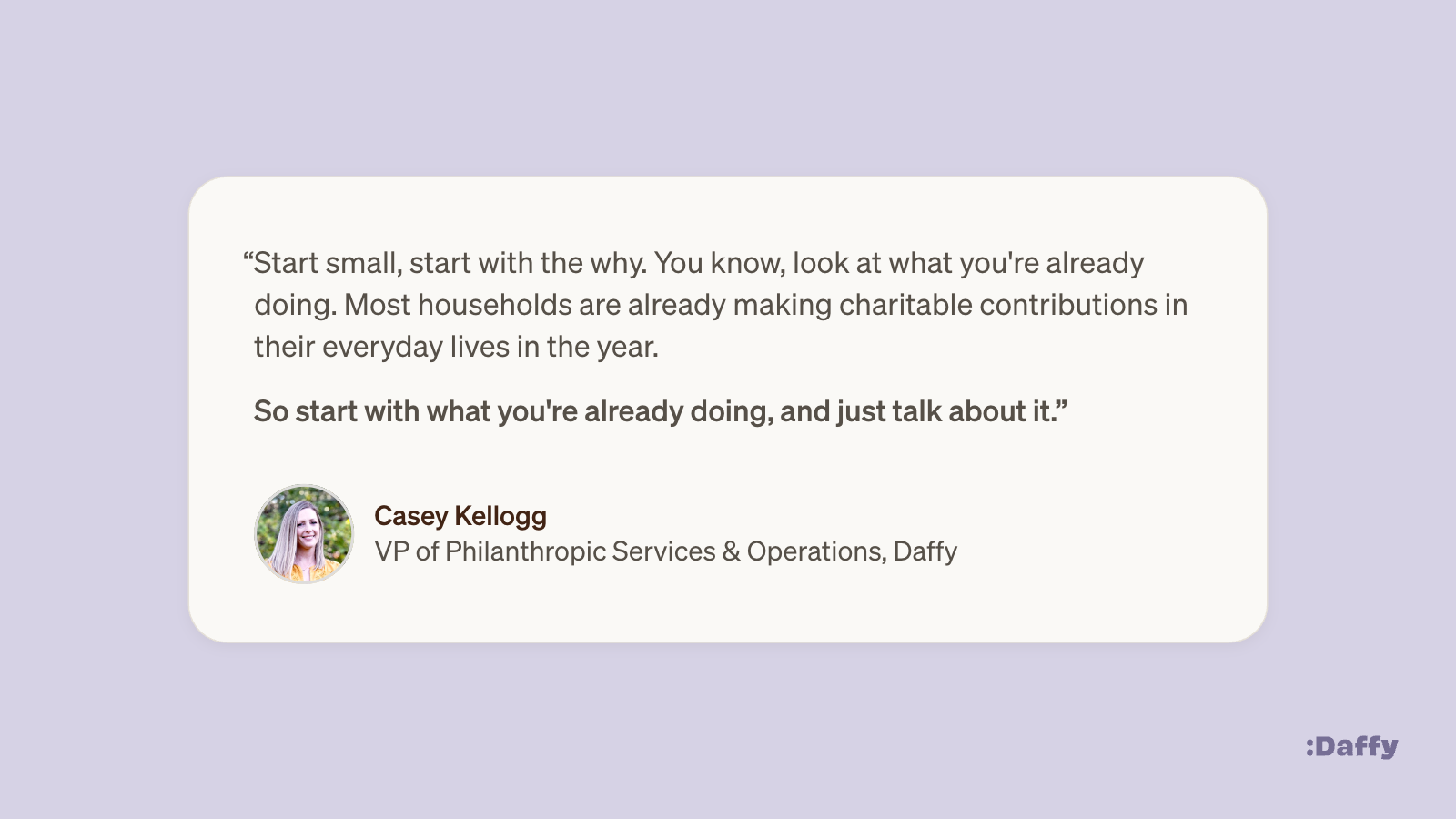
From there, talk about what your family values and how that shows up in the causes you support, where you volunteer, and how you spend your time. And let them actually see it, too. Bring them along when you volunteer, or sit beside them when you make a donation.
Casey Kellogg, Daffy's VP of Philanthropic Services & Operations, has young children of her own, and she sees how this plays out at home. Every year, her children's school holds a Ruby Bridges walk to teach students about school integration and civil rights. When her kids bring those lessons home, it creates an opportunity to talk about values like community and education, and explore organizations working on those issues. As Casey explains, the goal is to “connect the dots for them about how they can get involved.”
You don’t have to decide where every donation will go during that first conversation. Just listen. You might be surprised by what your children say about what matters to them. And if you’d like help putting your family’s values into words, this guide can help.
2. Set Something Aside and Give the Kids a Say
Talking about the causes your family cares about is a great place to start. But if you want your kids to have a real say in where your family gives, set aside money for them to use. Start by figuring out how much you can comfortably give each year, alongside your other financial priorities.
Research suggests that committing to give in advance can increase generosity by as much as 32%.
Pick an annual giving goal and break it into weekly or monthly contributions. Factor in donations you already make, and consider setting those up as recurring donations. You can also make one-time donations whenever something comes along that your children are excited to support. Just make sure to leave room for the charities they choose.
Younger children can choose from a short list of charities you’ve researched together, while older kids can find organizations on their own and explain why they want to support them. You can still set the amount they have to work with and talk through their choices. One idea is to give each child a set amount to donate, plus a shared amount the kids can decide on together.
But you don’t have to decide which charities your children support before setting money aside. A donor-advised fund (DAF) lets you contribute cash and other assets, like stock and crypto, now and decide where to give later. With Daffy, you can also automate those contributions.
If you have kids 13 or older at home, they can have their own Daffy for Families account. This lets them find charities they’re excited about and send you a donation request you approve. You still have the final say, but you’ll hear why it matters to them. And you all get to see the impact of that donation.
As your children get older and are ready to take more ownership of their giving, you can also gift them their very own Daffy fund to help them build their own lifelong habit of giving.
3. Make Your Giving Plan More Tax-Efficient
Once you’ve figured out how much your family can give, you can make those dollars go further by thinking about when and what you contribute. Under the new 2026 charitable deduction rules, the tax benefit depends on more than how much you give.
Say your family gives $10,000 a year in cash to your children’s school and a few other charities. You give because it matters to you, but how much of it can you actually deduct from your taxes?
Under the new 2026 rules, married couples filing jointly who take the standard deduction can deduct up to $2,000 in qualifying donations ($1,000 for individual filers). That’s a welcome benefit. But if your family gives $10,000, only a fifth of it is deductible. So it’s worth looking at whether itemizing could save you more.
Doing so depends on whether your eligible expenses, including mortgage interest, state and local taxes, and charitable contributions, add up to more than you’d take with the standard deduction. For married couples filing jointly, the standard deduction is $32,200 in 2026.
For families whose other deductions are already close to the standard deduction, charitable contributions can “push you over the edge to where itemizing makes a lot of sense,” says Chris Arnold.
One strategy that can help is bunching. Instead of contributing $10,000 each year for the next three years, you could put the full $30,000 into a DAF in a single year. Combined with other deductions like mortgage interest and property taxes, that larger contribution could make itemizing worthwhile. As Chris explains, “You get the tax benefit in the year that you fund the DAF.”
That doesn’t mean you have to give all $30,000 to charities at once. You can still recommend $10,000 in donations each year, and your children can help decide where some of those donations go.
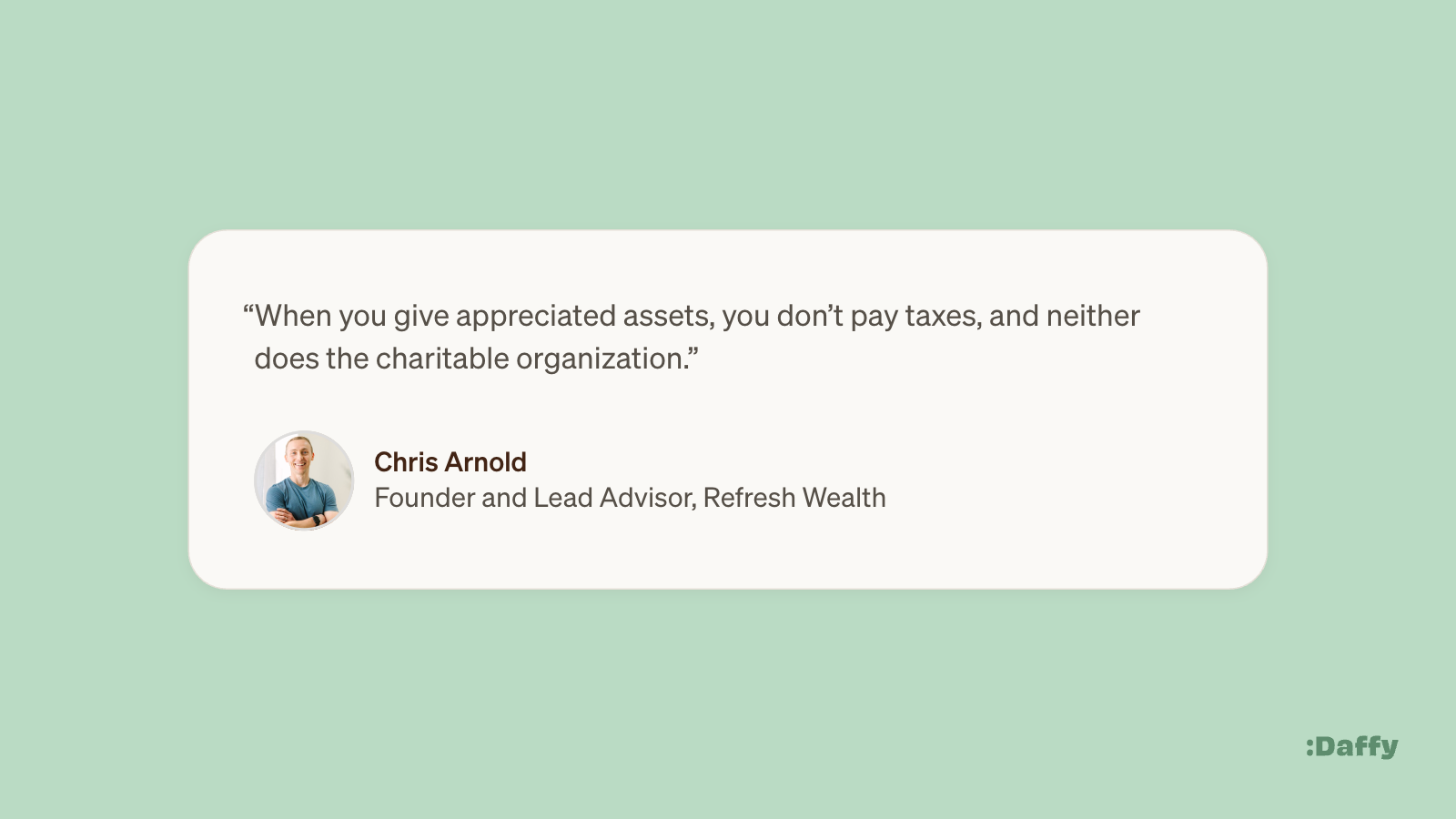
Another way to make your family’s giving go further is to donate appreciated stock, ETFs, or crypto you’ve held for more than a year directly to a DAF. Selling those assets first can trigger capital gains taxes, leaving less to donate. Giving the asset directly to a DAF avoids taxes on the appreciation, and you can deduct what it’s worth on the day you give it, so more of it reaches the charities your family chooses.
Let Your Children Find Their Own Reasons to Give
Nobody needs a family vote on every donation. What’s important is helping your children see why you give, while giving them opportunities to make some choices of their own. When you set aside money year after year, it becomes a family tradition your children grow up with.
Start with one conversation, one cause they care about, or one donation they help choose. As they get older, they can take on a bigger role in your family’s giving. They might be the ones coming to you excited about a cause they’ve discovered, asking how your family can help. And someday, they could pass the tradition on to children of their own.
If you’re ready to give your kids a bigger role in your family’s giving, you can start with Daffy for Families.
Frequently Asked Questions
How do I teach my kids about charitable giving?
Kids learn giving best when they see you do it and get to be part of it. Start with what your family already gives. Talk about why you give to those charities and what prompted it, then connect it to what your family values, like where you volunteer. From there, let your kids take part in the decisions. Younger children can choose from a short list of charities you’ve researched together, and older kids can find organizations on their own. You can set the amount they have to work with, such as an annual budget. With Daffy for Families, family members 13 and older get their own account and can recommend donations, and an adult fund organizer approves each one before it's sent.
How much should our family set aside for giving each year?
There’s no right number, and you don't need to have it all figured out to begin. Start with an amount your family can comfortably give alongside your other financial priorities, and break it into weekly or monthly contributions if that feels easier. Setting money aside in advance makes a difference, too. Research shows that committing to give in advance can increase generosity by as much as 32%. A donor-advised fund (DAF) like Daffy lets you set that money aside now and decide where it goes later, and you can automate your contributions so it happens without you having to think about it.
How does a donor-advised fund work?
A DAF works in three steps: contribute, invest, and donate. You open a DAF and contribute cash, stocks, ETFs, crypto, or other appreciated assets, receiving an immediate tax deduction. Your contributions can be invested across portfolio options and grow tax-free. When you’re ready, you recommend donations to IRS-qualified public charities on your own schedule — with no required distribution deadline.
Who can join Daffy for Families?
Once you sign up, you can add your children, grandchildren, siblings, nieces and nephews, and anyone else you consider family to your fund. We’ve designed Daffy for Families with plenty of room to include multi-generational families, with support for up to 24 members under one fund, and anyone 13 and over can be a member.
Do my family members all share a single Daffy account or do we each get our own account?
Each family member will get their own secure Daffy account. Each family member added to your fund can follow the charities that are most meaningful to them, request donations for approval, and receive notifications whenever anyone in your family makes a new donation.