
Imagine you’re in a casino. You sit down at the roulette table. You put $500 on a single number (it’s Vegas, baby!) and watch as the ball bounces around the spinning wheel. When it finally stops, it lands on your number. You can’t believe it. Your $500 is now $17,500.
Logically, you know that you should walk away and take what you’ve won. But there’s also a part of you saying, “Maybe it’ll happen again.”
We’ve all heard a version of this story, someone who was up but just couldn’t walk away from the table. But that “maybe” mindset also applies to stock.
Maybe you were early in Apple, Google, or even SpaceX. Maybe you’re an employee at a company that offers stock compensation. To you, owning those stocks doesn’t feel like a gamble. Over time, it appreciated until it became your most significant asset. Why give up on it now?
It can be risky to stay concentrated in a single company. But selling even a little feels like giving up too soon.
What if it keeps going up? What if you sell now and miss the next boom? What if you sell and your co-workers judge you? Parting with even a portion of it can feel almost superstitious, like you’re going to jinx the run.
It's hard to pull the trigger even though parting with some of it is usually the right move. But there’s another way to reduce your concentration without giving up on the company. You can donate those shares directly to charity.
You already give to charity every year, but chances are you’re donating cash. So if you’re already giving, why not consider donating some of that stock?
Not only does it reduce your concentration risk, but you can also skip the capital gains tax selling would trigger on the full amount you donate and claim a charitable deduction on the full amount. And if you use a donor-advised fund (DAF), you can recommend the shares stay invested, so they have the potential to keep growing, allowing you to give even more to charity.
Why selling a winning stock is so hard
It should feel easy to cash in your biggest stock. Your investment grew 10x! That’s real money you now have to spend or invest. But winners are hard to sell because you expect it to keep winning. Maybe it'll 10x again! Then there's the tax bill, which you know is there, so you put it off. And if the shares come from your employer, selling can feel like giving up on the company.
These are the three things that often get in the way.
1. You don’t want to pay a tax bill
Selling comes with a real cost in the form of taxes. That cost is tangible, while the cost of staying concentrated feels abstract.
Researchers have found this affects how people trade. A study comparing taxable and tax-deferred investment accounts found that investors were more reluctant to sell appreciated stock in taxable accounts, especially for larger transactions and longer-held shares.
So putting off a sale can feel perfectly sensible. Even when you’d still have a substantial gain, it’s easy to focus on the money you’d owe rather than the money you’d keep.
The tax liability is always there, but it doesn't feel real until you sell and see the math.
This is what Daniel Kahneman and Amos Tversky called “loss aversion.” Kahneman defined it as: “The response to losses is stronger than the response to corresponding gains.”
No wonder holding on can feel like the safer choice. But it doesn’t make the concentration risk go away.
2. Never tired of winning
Once you’ve watched a stock multiply in value, another big run doesn’t seem that far-fetched. After all, it’s already happened! So you expect the next few years to look a lot like the last few.
And that expectation can influence what you actually do. A 2026 study published in the *Journal of Financial Economics* found that investors who were more inclined to project past performance into the future were less likely to sell stocks with large gains.
Economists call this extrapolation bias. It’s the assumption that what a stock has done recently is what it will keep doing.
But a big run doesn’t mean another one is coming. For example, Circle went public in 2025, and its stock traded as high as $299. A year later, it was trading around $85, down more than 70% from that high and near where it closed on its first day of trading.
Anyone who held through the peak watched most of that run disappear. That doesn't mean the stock is bad. It just means expecting it to keep climbing at the same rate is unlikely.
And if the stock has fallen from its peak, you may keep waiting for it to climb back.
It’s also not always about the money. It might be that you’re anticipating regret. Behavioral finance calls this regret aversion. You’re avoiding a decision because of how bad you’d feel if it turns out wrong.
There’s also the social aspect. If everyone you know is holding that same stock and you sell, what if they make a killing and you don’t? Those friends may laugh at you for having “paper hands” while they have “diamond hands.”
3. Company conviction
If the shares come from your employer, selling can feel even more personal. Why would you work for a company you don’t believe in?
Psychologists call that tension cognitive dissonance: the discomfort of holding two ideas that don’t fit together. Here, those ideas are “I believe in this company” and “it’s risky to hold this much of its stock.”
Being inside the company can also feed confirmation bias.
You know the products, the people, and the work that went into its success. It’s easy to feel like you see something other investors don’t. And sometimes you do. But that familiarity can also make it harder to notice evidence that challenges your optimism.
But if your income, benefits, and largest appreciated asset are tied to a single company, all of your eggs are in one basket. So diversifying what you can — your stock — is the typical way to reduce your risk.
Why your most appreciated stock is often the best one to donate
There’s a difference between believing a stock still has room to run and deciding you need to own every share you’ve held.
Most people think of charitable giving as writing a check. But you can also donate appreciated shares themselves, either to a charity that accepts stock or through a donor-advised fund (DAF), a charitable giving account that lets you recommend donations to charities over time.
The irony is that the very gains that make those shares so hard to sell can also make them particularly advantageous to donate.
If you donate eligible shares to a DAF instead of selling them, you generally don’t pay taxes on the capital gains. If you’ve held them for more than a year, you can also qualify for a charitable deduction based on their full market value, subject to applicable rules and limits.
Consider a long-time SpaceX employee whose company stock has become one of their largest assets. Let’s say they currently hold 2,000 shares, worth $135 per share, for a total of $270,000. Those shares also have a cost basis of $40.
That means they have $190,000 in unrealized gains. Selling those 2,000 shares would trigger roughly $69,000 in capital gains taxes.* Even selling a portion would trigger a significant tax bill.
But donating can help. If they're reluctant to sell due to paying taxes, they can sell some shares and donate another portion of the same stock to a DAF in the same tax year. That donation can help offset the tax from the sale.
Let’s say this SpaceX employee sells 300 shares and donates 220, holding onto the remaining 1,480.
Here’s how it works:
- Sell 300 shares: They get $40,500 in proceeds and realize a $28,500 gain, which means about $10,289 in capital gains tax.
- Donate 220 shares: They can deduct the shares’ $29,700 market value and skip the tax on the shares’ $20,900 gain.
- The outcome: The $29,700 deduction can lower their federal tax bill by up to about $8,995, helping offset the $10,289 they owe on the sale.*
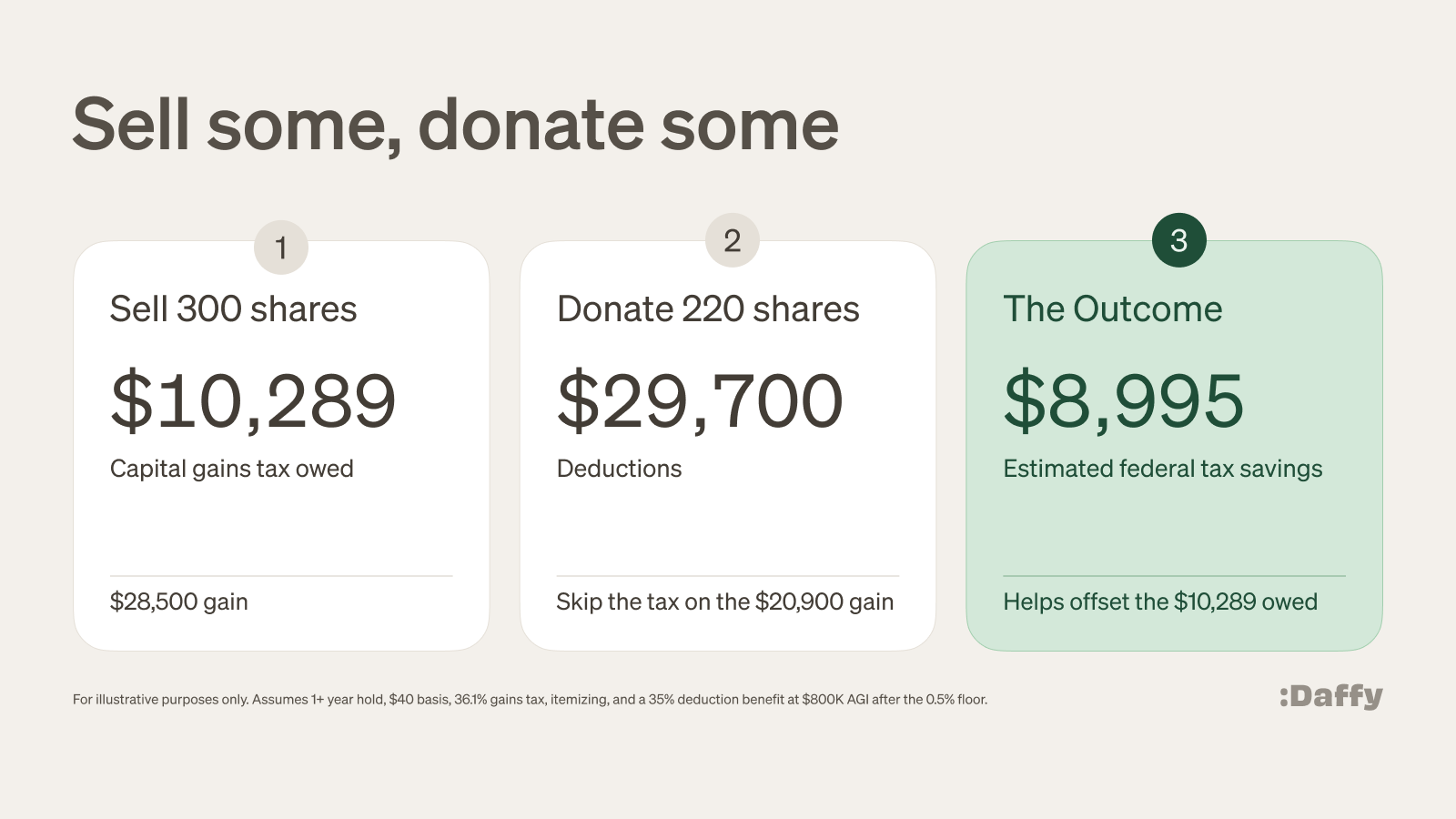
This SpaceX employee was able to reduce their concentration, help offset their taxes from a sale with their donation, and still support charity.
Plus, they still hold 1,480 shares and remain invested in SpaceX.
But what if you’re reluctant to donate, not just because of the taxes but because you think the stock will continue to appreciate?
Donate and still give the stock room to run
When you contribute stock to a DAF, it’s an irrevocable donation. Generally, the shares are sold shortly after you transfer them, and the proceeds are invested until you’re ready to recommend donations to charities.
You may have been comfortable giving away the shares. But having them sold right away can feel like giving up the very thing you were hoping to keep: future appreciation.
That’s where Custom Liquidation comes in.
It lets you recommend that your donated shares be held for a period of time, sold gradually, or liquidated immediately.
If the shares are held or sold gradually, and the stock keeps climbing, those additional gains could eventually benefit the charities you support.
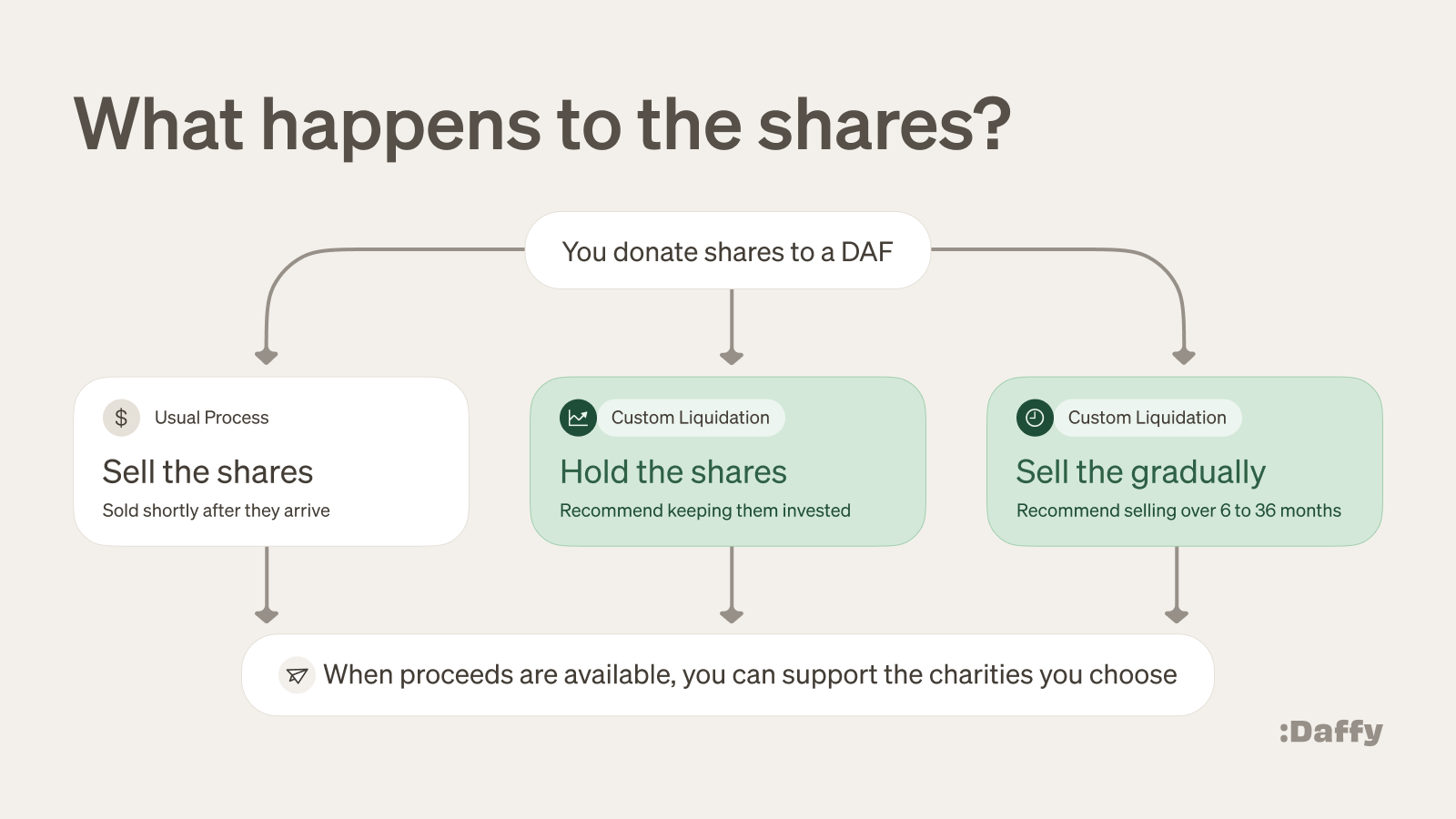
Custom Liquidation isn’t only for public stock. You can make similar liquidation recommendations for private stock.
Once the shares are sold, all proceeds are invested in your account’s portfolio. At Daffy, that is either one of our pre-built portfolios or a custom portfolio, selected from over 680 ETFs and 2,200+ individual stocks, where the money can keep growing tax-free until you’re ready to donate.
Here's what it looks like at Daffy:
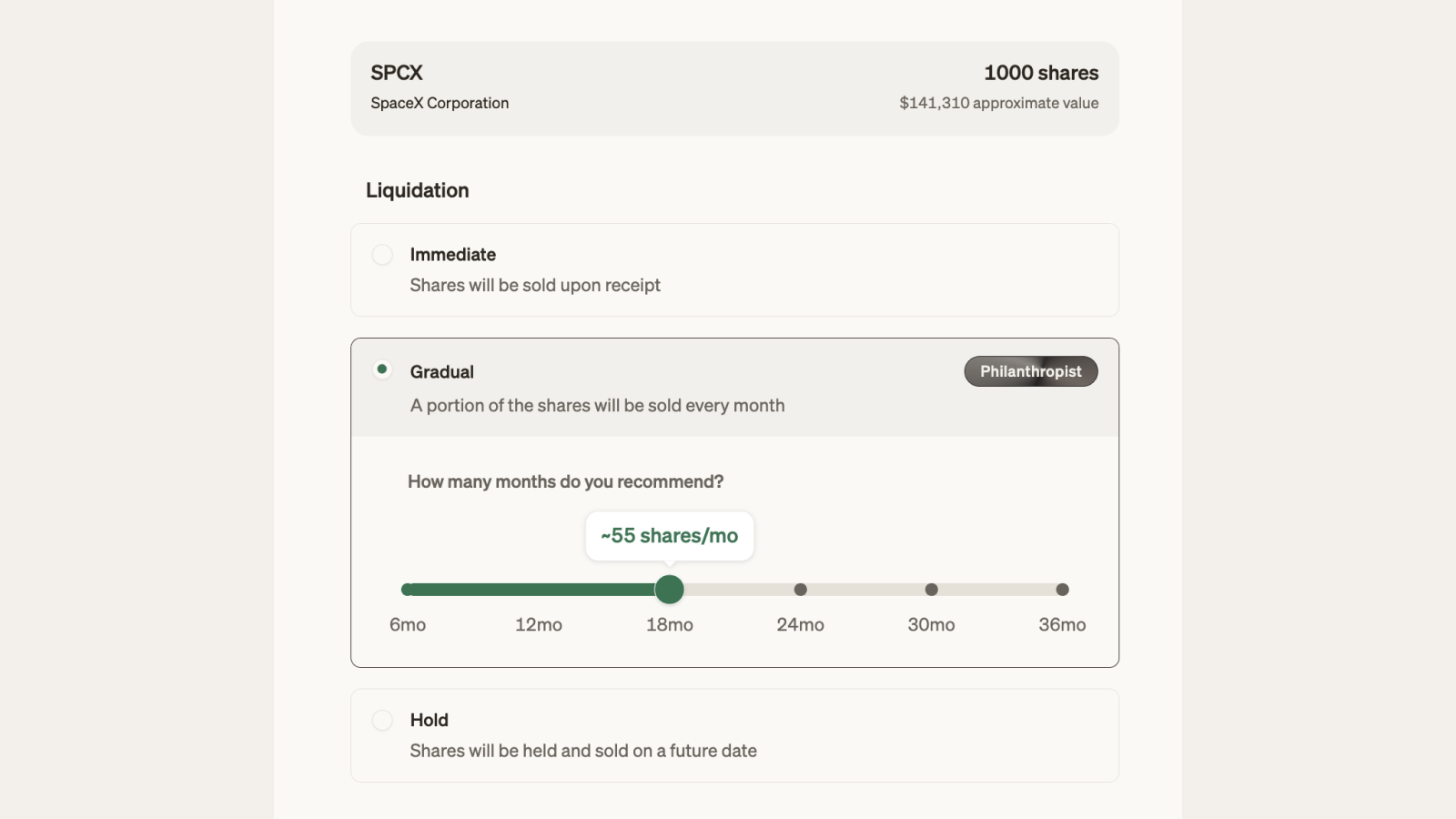
Maybe the stock keeps climbing. Maybe it doesn’t. You don’t have to call the peak to decide how much you’re comfortable giving.
Whatever happens next for the company and its stock, your generosity doesn’t have to wait.
Frequently Asked Questions
Can I donate appreciated stock to a donor-advised fund?
Yes, you can donate appreciated stock to a donor-advised fund like Daffy. Most charities can’t accept stock directly, but a donor-advised fund can. Once you’re a member, you can send nearly any publicly-traded stock, ETF, or mutual fund straight from your brokerage account. If you’ve held the shares for more than a year, you generally avoid the capital gains tax you’d owe by selling them, and if you itemize, you can deduct their full market value.
Can I donate stock to charity instead of cash?
Yes, you can donate stock to charity instead of cash. Instead of selling your shares and giving the proceeds, you transfer the shares themselves, so don’t sell them first. Selling is what triggers the capital gains tax. You start the transfer with your brokerage, and Daffy can submit it for you if you’re at Schwab or E*TRADE.
What’s the most tax-efficient way to donate to charity?
Donating appreciated stock you’ve held for more than a year, instead of cash, is generally the most tax efficient way to give. You avoid the capital gains tax you’d owe by selling the shares, and if you itemize, you can deduct their full market value. Giving through a donor-advised fund like Daffy also lets you take the deduction in the year you contribute and choose the charities later.
Is it better to donate stock directly to charity or through a donor-advised fund?
Most charities can’t accept stock directly, so a donor-advised fund is often the easier route. You send the shares to your fund once, get your deduction that year, and then recommend donations to nearly any 501(c)(3) public charity, including schools and churches that aren’t set up to take stock. If one charity can accept your shares and you want it to have them right away, giving directly works too.
Does Daffy sell my shares right away?
Generally, yes. Donated shares are sold shortly after they arrive, and the proceeds are invested in your fund until you’re ready to donate. With Custom Liquidation, eligible members can recommend that Daffy hold the shares for a period of time, sell them gradually, or sell them right away. It’s a recommendation, since the donation is irrevocable and Daffy makes the final call.
*This hypothetical example is for educational purposes only. Consult a financial or tax professional about your own situation. It assumes a SpaceX share price of $135 (rounded from the October 30, 2026 closing price), shares held more than one year, a $40 per share cost basis, and a 36.1% tax rate on gains (20% federal long-term capital gains, 3.8% net investment income tax, and an assumed 12.3% California rate). Deduction savings are federal only and assume a single itemizer with $800,000 in adjusted gross income (AGI) in the top 37% bracket, where itemized deductions save 35 cents per dollar in 2026, and no other charitable gifts this year. After the 2026 0.5% AGI floor, ($29,700 − $4,000) × 35% = $8,995. Deductions for donated stock are generally limited to 30% of AGI, with the excess carried forward up to five years.