
As the year winds down, you probably have a clearer picture of your income and what you might owe in taxes. Maybe a big bonus, RSU vest, or your spouse’s job change pushed your income higher than you expected. Now you’re wondering what you can do to reduce next April’s tax bill before the end of the year.
Have you considered donating stock to charity? During a recent webinar Daffy hosted with Titan, a wealth management firm for tech professionals, 83% of respondents said they hadn’t. But they were interested. And for good reason.
Donating shares can offer what Giovanni Tiso, CFP®, Titan’s lead financial planner, calls “unlockable tax savings and diversification.”
But as Giovanni emphasizes, it all starts with one question: “What are your goals?”
Here are four ways you could approach it.
1. Donate Appreciated Stock Instead of Cash
If you already give, are you giving in cash or using a credit card? Because if you do, donating appreciated shares should be the first thing you consider.
According to Giovanni, “A lot of times I'll say to clients, giving in cash is one of the most expensive ways you can give to charity.”
That’s because if you have stock that’s gone up in value, you’re missing out on potential tax savings. By donating the shares instead, you avoid paying the capital gains tax on the difference between what you paid (your cost basis) and what it’s worth today (the fair market value). And if you itemize and have held the shares for more than a year, you can qualify for a charitable deduction on the fair market value.
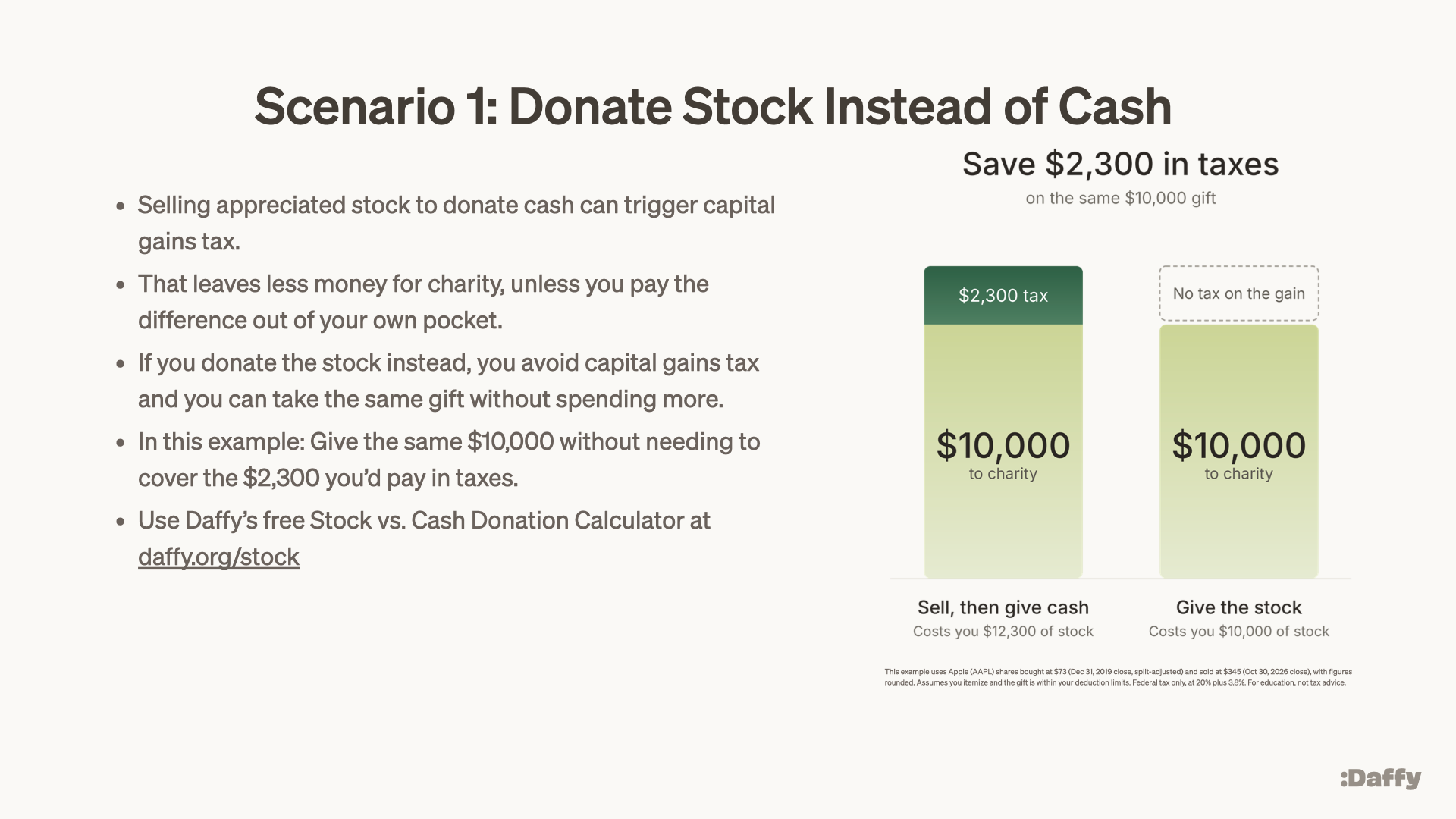
Say you want to give $10,000 to charity, and you have Apple shares you acquired years ago. Let’s assume they’ve appreciated a lot, so you have a large gain and a relatively high capital gains tax rate. You might need to sell roughly $12,300 worth of shares to have $10,000 left to donate after taxes.1
But if you donated $10,000 worth of shares directly, you could make the same amount without triggering that tax. So you don’t need to sell more for the same donation, and you don’t need to reach into your pocket to make up the difference.
What if you still want to stay invested in the stock? Well, there’s a strategy for that too.
Giovanni explains that you could donate your appreciated shares, “get the gain out of your name, and then just repurchase it with the cash that you were intending to donate anyway. Now, we reset the cost basis.”
Most charities don’t accept stock directly, and that’s where a donor-advised fund (DAF) like Daffy comes in. You can contribute your shares, claim a deduction that year, and then decide which charities to support later.
If you want to see how much you could save by donating stock instead of cash, try Daffy's free Stock vs. Cash Donation Calculator.
2. Donate Stock in a High-Income Year
Some years, all that hard work really pays off, and you earn more than expected. No one’s going to complain about that. But you probably won’t like the tax bill.
Donating appreciated stock in a year like that can help take the sting out of what you owe, especially if that extra income pushes you into a higher tax bracket.
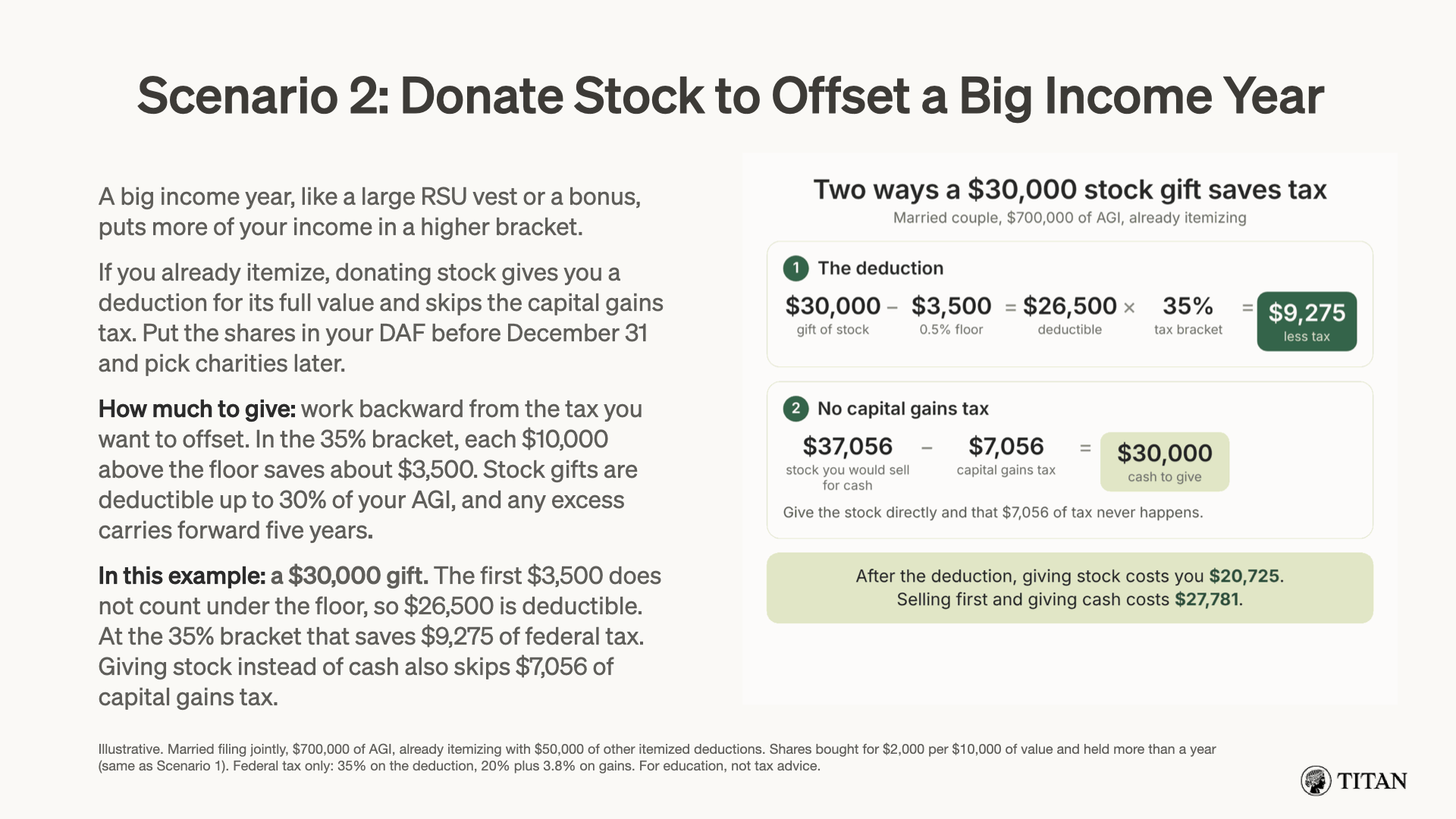
For example, say an RSU vest pushed your household’s income to $700,000 this year. If you donated $30,000 worth of appreciated shares, you’d save roughly $9,300 in federal income taxes under the assumptions in our example, while also avoiding capital gains tax on those shares.2
That sounds great, but that’s just one example, and your situation probably looks different. So how do you figure out what makes sense for you?
Giovanni says his team spends a lot of time at year-end “helping folks pick both the optimal amount to donate, and then what shares.” A good place to start, he recommends, is whether you take the standard deduction or itemize. That’s especially important under the new 2026 rules.
If you itemize, only contributions above 0.5% of your AGI are deductible. So the first $3,500 of the $30,000 donation doesn’t count in this example.
And if you’re donating stock you’ve held for more than a year, there’s another limit to keep in mind. You can generally deduct up to 30% of your AGI, but if your donation exceeds that amount, you can carry the rest forward up to five years.
3. Sell Some Stock, Donate Some
What if you’re already planning to sell stock, either because you want the cash or want to reduce your exposure to one company? Consider selling some shares and donating others. That way, you can still get the cash you need while offsetting the tax you’ll owe on the sale.
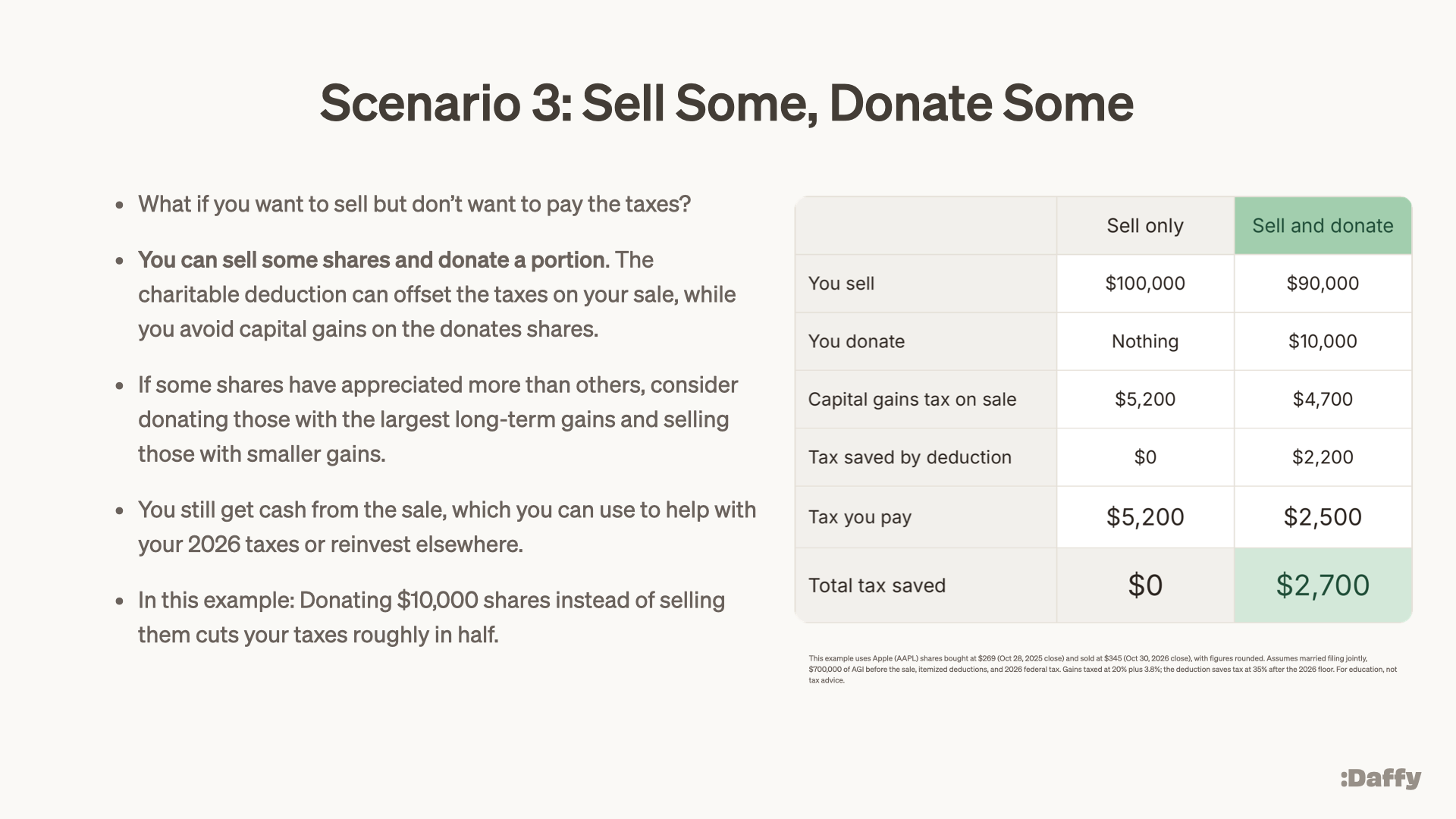
Say you’re planning to sell $100,000 worth of Apple stock. In this example, you’d owe roughly $5,200 in federal capital gains tax on the sale.3
But what if you sold $90,000 worth of shares and contributed the remaining $10,000 in stock to your DAF? You’d still receive $90,000 from the sale, but you’d avoid capital gains tax on the donated shares. And if you itemize, the charitable deduction can help offset the taxes on the shares you sold.
So instead of owing $5,200 in taxes, you’d cut that down to about $2,500.
OK, but does it matter which shares you donate? Actually, it does.
As Daffy co-founder and CEO Adam Nash points out, the best candidates may be “some sleepy index fund ETF shares that you’ve held for 15 years,” rather than the company stock you just vested.
So before you decide which shares to donate, look across your entire portfolio (and your spouse’s too!). You might find some stocks or funds you’ve held for years that have appreciated a lot more than your company stock.
4. Combine Several Years of Giving Into One
If you give to charity regularly, your donations might not be lowering your taxes at all, especially if your deductions aren’t high enough to make itemizing worthwhile.
That’s where a strategy called “bunching” comes in.
Say a married couple with $400,000 in AGI and $22,000 in other itemized deductions donates $10,000 worth of appreciated stock every year. Their deductions never exceed the standard deduction, so they don’t receive an additional income-tax benefit from those donations.
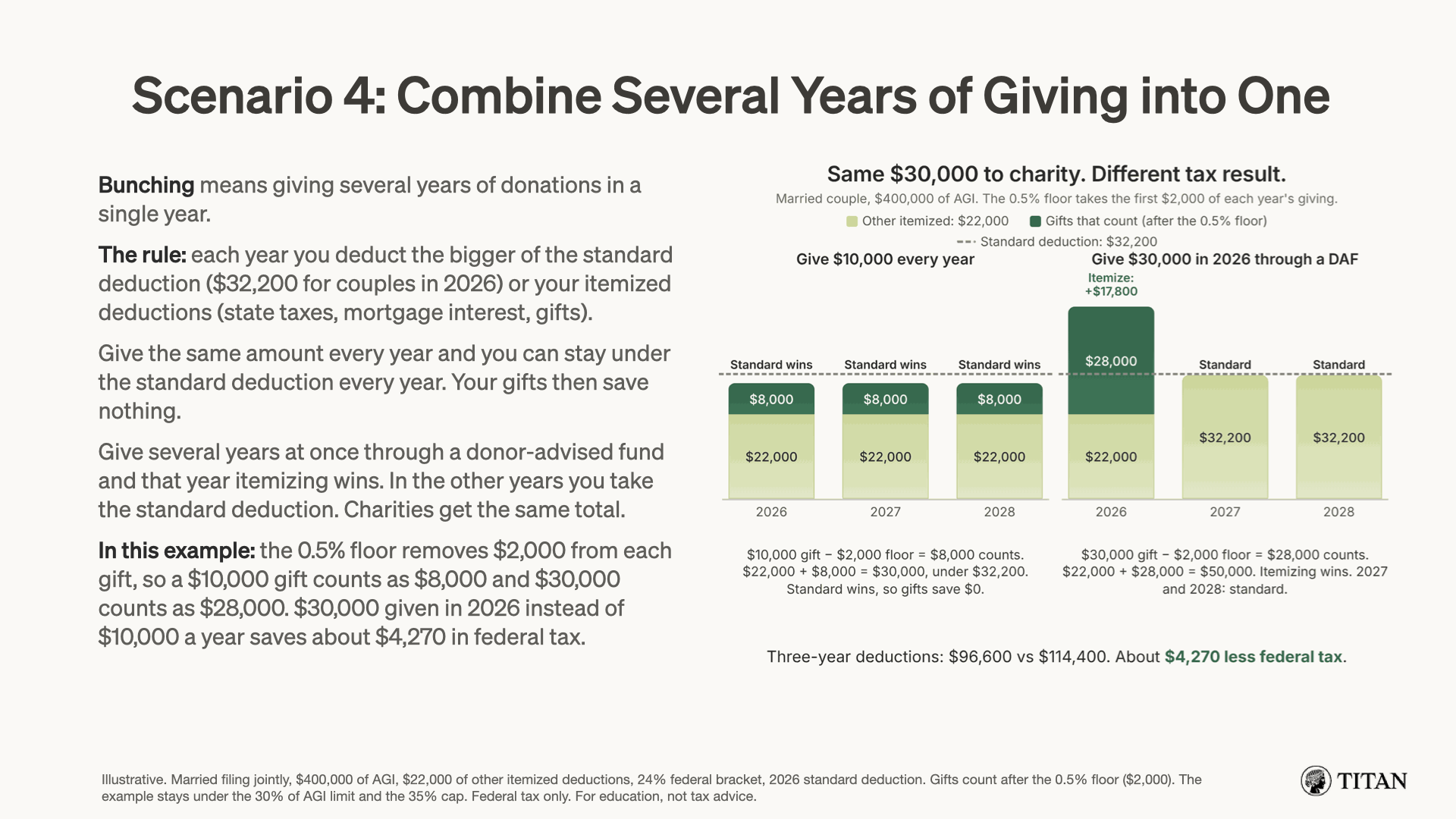
But if they contribute $30,000 to their DAF in one year — such as appreciated stock — then recommend $10,000 in donations to their favorite charities as usual, they can itemize that year and take the standard deduction in the other two. That saves them roughly $4,270 in federal income taxes over three years.4
As Giovanni puts it, “The amount that goes to charity is the same, the tax benefit changes.”
Which Approach is Right For You?
Maybe one of these approaches makes sense for your situation, or maybe it’s a combination of a few. The important thing is that the shares you donate, and when you donate them, can make a real difference on your tax bill.
And if you’re not sure where to start, you don’t have to figure it all out on your own. Titan can help you think through your options, and Daffy makes it easy to donate stock and support nearly any U.S. 501(c)(3) public charity.
Frequently Asked Questions
Is it better to donate stock or cash?
If you've held appreciated stock for more than one year, donating the shares directly can be more tax-efficient than selling them and donating the cash. When you sell appreciated stock, you may owe capital gains tax on the increase in value. By donating the shares directly, you can avoid realizing those capital gains and, if you itemize, you can also deduct the stock's fair market value. That can mean more money goes to charity and less goes to taxes.
What is bunching, and does it work with stock?
Bunching is a tax strategy where you combine several years of charitable contributions into one year to potentially maximize your itemized deductions, then take the standard deduction in other years. A donor-advised fund like Daffy makes it practical, since you take the deduction when you contribute and keep recommending donations to charities on your own schedule. Bunching works with both cash and stock, and donating long-term appreciated stock offers an additional benefit: avoiding capital gains taxes on the donated shares.
How do I donate stock on Daffy?
Most charities can't accept stock directly, so the easiest path is through a donor-advised fund like Daffy. Once you're a member, you can contribute nearly any publicly traded stock, ETF, or mutual fund directly from your brokerage account.
Daffy offers direct transfers from E*TRADE and Schwab, along with simple transfer instructions for other brokerages. Once your contribution is complete, you can recommend donations to more than 1.7 million charities through Daffy.
Can I donate RSUs to charity?
Yes, you can donate RSUs to charity once they vest. Your cost basis is the share price on the day they vest, and the vest itself is taxed as income. If you've held the shares for more than a year, you generally avoid the capital gains tax, and if you itemize, you can deduct their full market value. If you've held them for a year or less, your deduction is generally limited to your cost basis.
What is the deadline to donate stock for it to count on this year's taxes?
To qualify for a tax deduction this year, Daffy must receive your stock by December 31 at 11:59 p.m. PT. The deadline is based on when Daffy receives the shares, not when you initiate the transfer.
Because transfer times vary by brokerage and are outside of Daffy’s control, we recommend starting your stock contribution as early as possible. Waiting until the final days of December could mean your shares don’t arrive in time to count toward this year’s taxes.
Titan Global Capital Management USA LLC (“Titan”) is an SEC-registered investment adviser. This content is for informational purposes only and should not be construed as investment, tax, or legal advice. Outcomes vary based on individual circumstances. Titan is not a partner or affiliate of Daffy, and Titan’s participation is not an endorsement of Daffy or its services. All investments involve risks, including the potential loss of principal. See www.titan.com/legal for additional disclosures.
Footnotes
- The Apple example is illustrative, based on shares purchased at a split-adjusted $73 and valued at $345, assuming a 23.8% federal long-term capital gains tax rate. Actual results depend on individual circumstances.
- llustrative example assumes a married couple filing jointly, $700,000 in adjusted gross income, $50,000 in other itemized deductions, and a $30,000 donation of appreciated stock held for more than one year. After the $3,500 charitable deduction floor, $26,500 is deductible. At an assumed 35% federal tax rate, that produces $9,275 in income-tax savings. Actual results depend on individual circumstances.
- Illustrative example uses Apple shares purchased at $269 and valued at $345, assumes married filing jointly with $700,000 in adjusted gross income before the sale, itemized deductions, a 23.8% federal long-term capital gains tax rate, and a 35% income-tax benefit on the deductible portion of the donation under 2026 rules. Actual results depend on individual circumstances.
- Illustrative example assumes a married couple filing jointly with $400,000 in annual adjusted gross income, $22,000 in other itemized deductions, and $10,000 in annual charitable giving. Using the 2026 standard deduction of $32,200, a 0.5% AGI charitable deduction floor, and a 24% marginal federal income-tax rate, contributing $30,000 in one year instead of $10,000 annually produces approximately $4,270 in additional federal income-tax savings over three years. The example assumes the same income and 2026 tax rules across all three years. Actual results depend on individual circumstances.